
Peruze
SAS-sponsored B2B AI Tool
Date
Spring 2025
Type
Academic project at NC State University
Team
Nicholas Arthur
Makaela Bullock
Katie Kirk
UI/UX design
Product design
Figma prototypes
Overview
With expert guidance from designers and engineers from SAS, my studio was given the task of designing AI-powered products that facilitate B2B interactions. My team was assigned retail as our area of focus.
My Role
I designed the visual identity of our product, which included the logo, logo animation, brand colors, and most UI elements within the prototype. For the final product, I designed and prototyped all elements for the dashboard, search filters, search results, map, and property detail pages.
In addition to design, I spearheaded the documentation of my team's process from initial research to our final presentation to SAS.
The Product
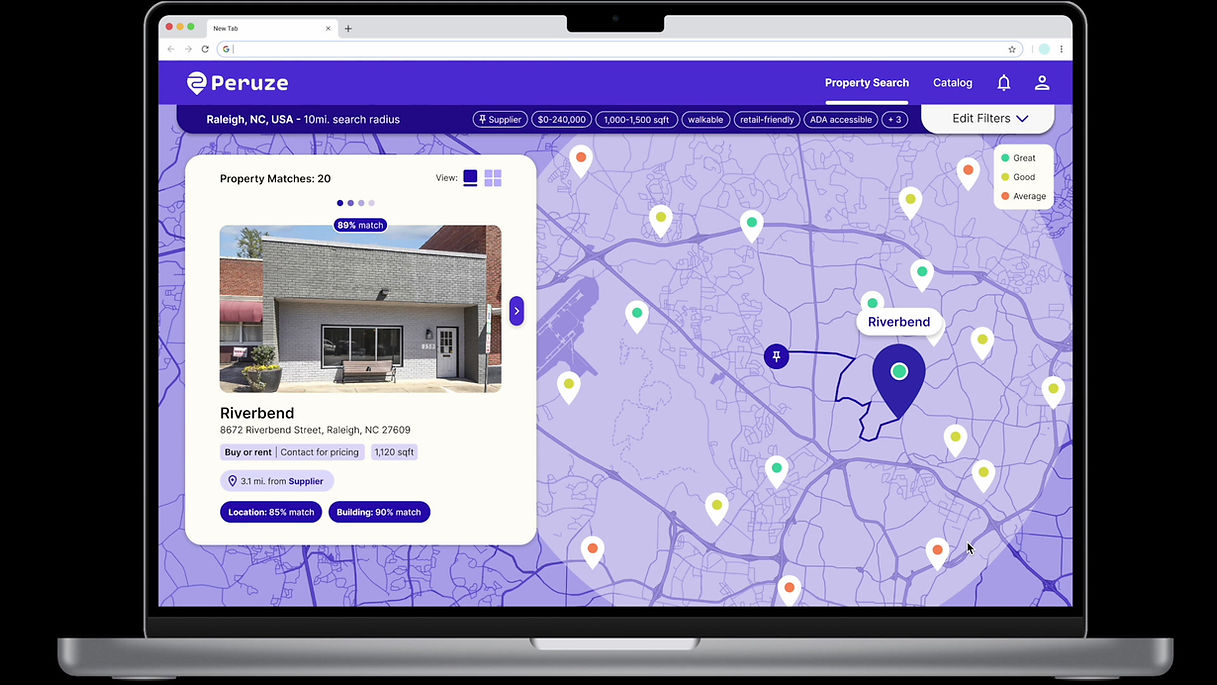
My team designed a commercial real estate website called Peruze, which leverages AI to match users with properties tailored to their unique business needs and easily deliberate between cataloged listings. This prototype follows the steps of Celeste, who is in the market for a new storefront for her clothing boutique.
The Process
1 - Research
My team began by researching how AI is being implemented in retail services, such as predicting sales trends, monitoring data, and automating inventory management. From our findings, we zeroed in on three specific areas that could use AI intervention: operation sustainability, location affordances, and demand forecasting.
My team explored the three ideas by:
-
Proposing the role AI could play
-
Looking into existing AI tools that could be implemented
-
Researching competitors that implement AI tools
-
Creating business personas and analyzing how AI can alleviate their specific challenges
Focusing the scope of the problem helped us find various AI tools and API's that could be implemented seamlessly within a product. We felt most drawn to property probing since it combined the essence of our other ideas into a more holistic product. This began our journey into the realm of commercial real estate, and how AI can be pushed to offer a new experience.


Next step: Figure out how to combine these siloed ideas in a way that feels natural.
2 - Product Overview
Once we settled on commercial real estate as our focus, we got to work defining how sustainability and demand forecasting play a part. Here is our first product statement:
"A real estate platform powered by AI to generate comprehensive reports on commercial properties through interactive maps that allow business owners to efficiently search for, analyze, and locate retail spaces that align with their specific goals."
Sustainability and demand forecasting represent two factors in a broader system of customizable features that allow retailers to prioritize what they want most from a space.

Concept map illustrating the relationship between real estate, sustainability, and demand forecasting.
Next step: Define the resources needed to make the product a customizable experience through AI.
3 - Data Repositories & AI Tools
We found several sources that publish open source data that are used by real estate platforms like Zillow, which serve as our main inspiration for the basic function of our product.
Data repositories
-
Public real estate data: Property listing information, property valuation, construction, etc.
-
National Association of Realtors Research: Reports and insight on residential and commercial markets
-
PolicyMap: Data and mapping platform offering real estate data like property values, housing market data, and demographics
AI and API's
-
Zillow API: Integrating their available real estate data
-
MLS (Multiple Listings Service) API: Integrate listings from multiple sources and provides comprehensive property information
-
Parabola: AI extraction of information from API databases
-
Onboard Area API (by ATTOM): Property, neighborhood, point of interest, and community data
Next step: Establish personas to explore the opportunities created by our product.
4 - Persona Development
One of the intentions behind our product—and why we worked hard to incorporate aspects of sustainability and demand forecasting—is to cater to different kinds of businesses. So, our personas are very different in scale and industry.
For our small-scale business, we chose a local clothing boutique whose owner wants to move to another location. As for our large-scale business, we went with the district manager of Chipotle looking to open a restaurant in a growing city.


These individuals have unique location, infrastructure, and consumer needs, and although the scales of their businesses are drastically different, they share a common goal: finding a property that accommodates their needs. In creating these personas, my team became confident that our product leverages AI effectively for users to make decisions by easing the process of property searching, regardless of what the process entails.
Next step: Begin developing the product by creating task flows.
5 - Task Flows
Celeste's journey in growing her business is what my team decided to focus on. Her desire to uphold sustainable practices and increase her customer base allowed us to design a responsive system that touches on the core ideas we started with. Our preliminary task flow is very basic, but it highlights one of the main features—generating reports on properties.

Initial task flow
Our next task flows are more detailed and comprised of three main sections: business profile, property search, and comparison reports.
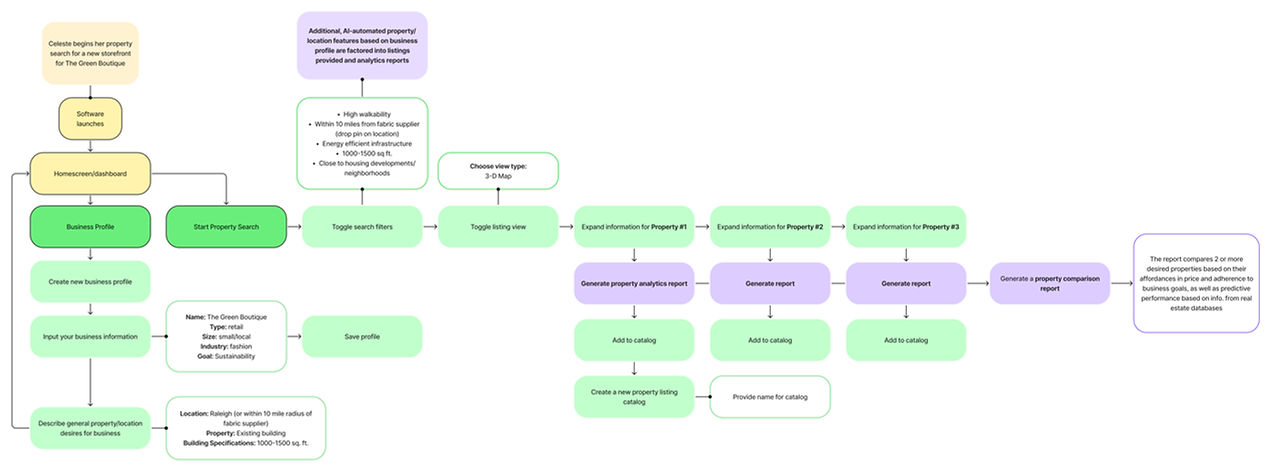
Task flow #2
Our second task flow shows more detail to get a better picture of how things work and what decisions Celeste makes. Building a business profile allows users to provide information about their current property and describe their desired one. This step is contextual and not actually part of Celeste's present actions, but it's crucial for showing how she gets tailored property matches and reports.

Task flow #3
For the third task flow, I clearly defined Celeste's situation:
Celeste is continuing her property search with a new commercial real estate website she discovered. She has found several viable options for a new storefront but is wavering between two that both seem great. Navigating to the catalog page of the website, where she has saved other property listings for future reference, she prompts a comparison analysis between her two favorites. Her goal is to finally make a decision about which property will be most beneficial for her business so she can contact a leasing agent.
Next step: Start designing low-fidelity wireframes to visualize the task flow.
6 - Wireframes
Taking the time to flesh out task flows made it significantly easier to begin the wireframing stage. We dedicated a lot of time to researching and framing, so it was exciting to start designing!




Lo-fi wireframes
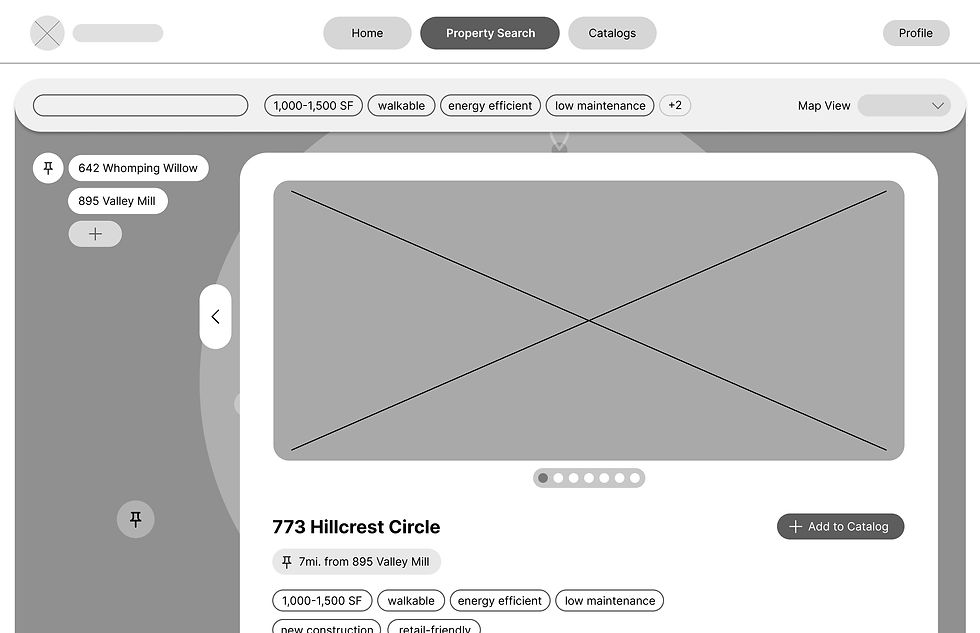
This first set of wireframes I designed shows the flow from Celeste's dashboard to an AI data visualization forecasting the impact of the property's location on her business.
The key features of our product shown in this flow are as follows:
-
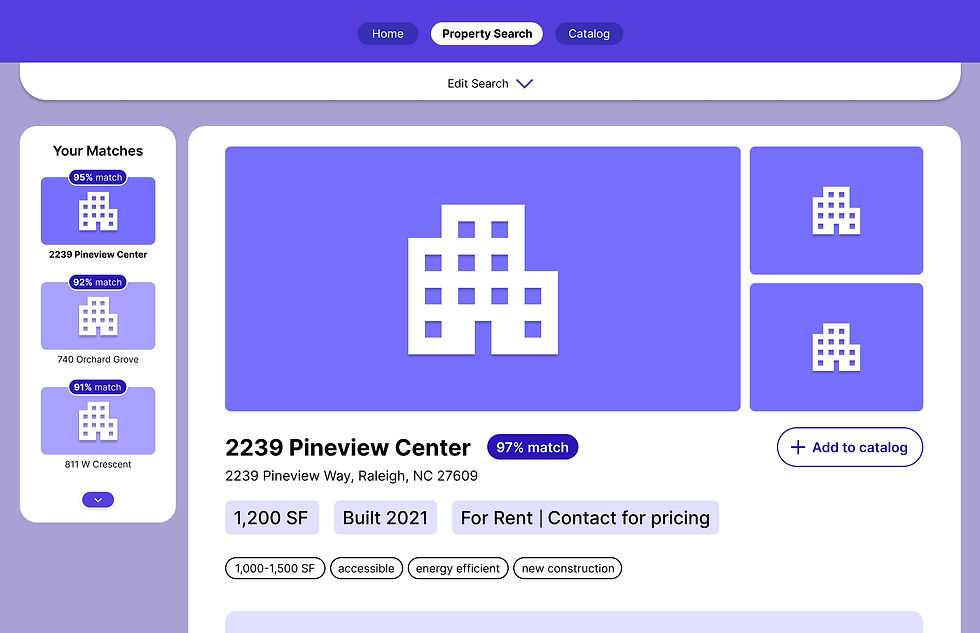
Property matches: The dashboard shows suggests properties that are high matches based on users business profile and activity (like what kind of properties are cataloged)
-
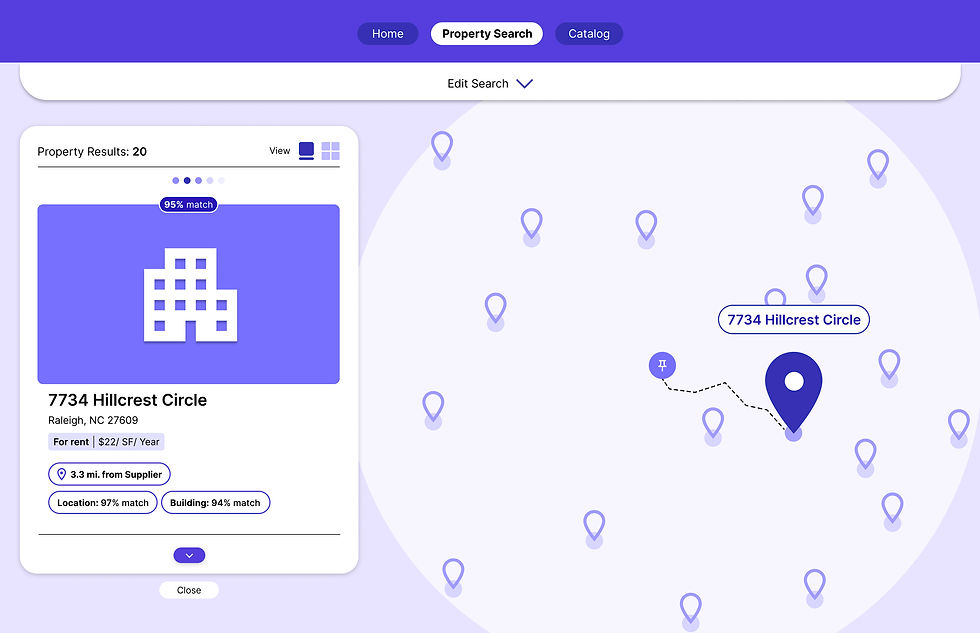
Search: The property search tab is populated with categories and tags that users can select and edit to narrow their search.
-
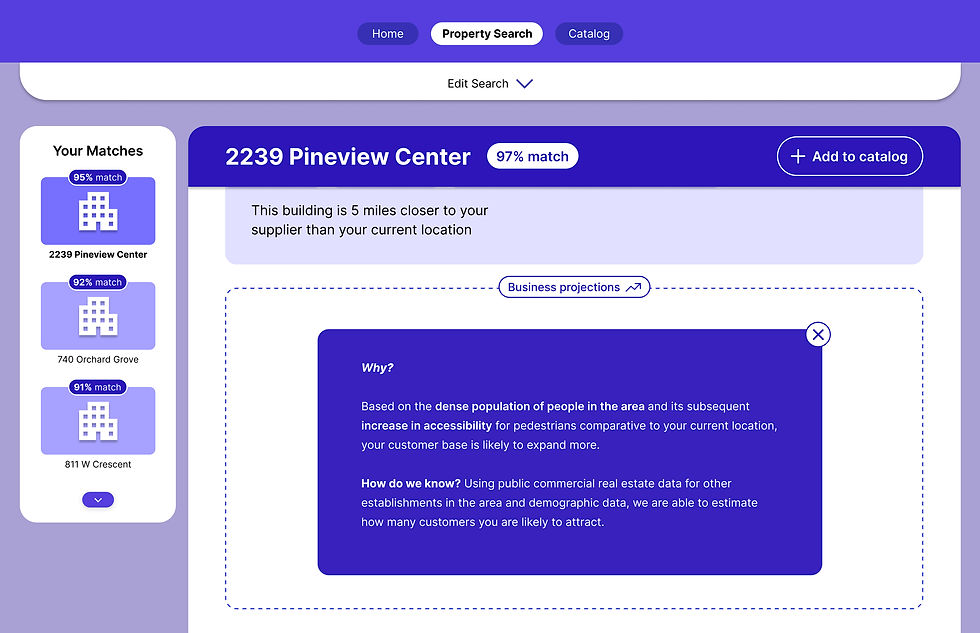
Listings: Our product shows users information that is important to them first. Celeste is concerned with accessibility, so the listing provides data on foot traffic and how it will impact her customer base. These specs also have a match rating based on how likely they are to satisfy user's business goals. AI is used to provide these ratings, as well as business forecasts, to show how these trends will develop over time.


Mid-fi wireframes
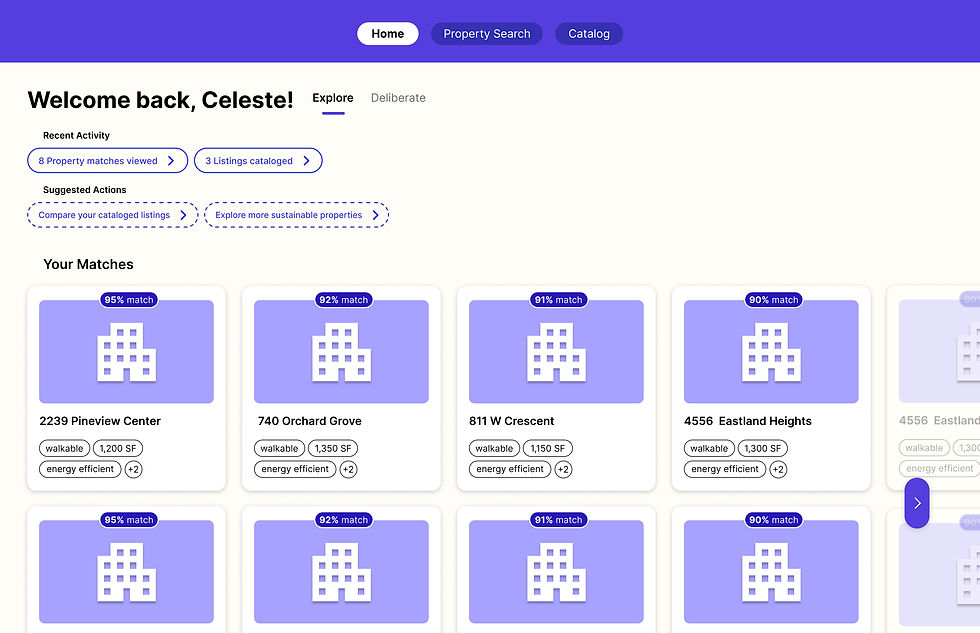
I made some crucial changes to this round of wireframes. These had to do with how AI was represented and just making features more streamlined. Here's what we improved:
-
Dashboard AI: In addition to suggested properties, the dashboard also suggests actions. In Celeste's case, the AI is recommending her to initiate a comparison report of her cataloged listings and explore more sustainable properties. The use of AI to nudge users by reminding them of goals they set makes the product more responsive.
-
Personalized search feature: We made the distinction between AI-suggested filters and user-selected filters clearer. The way more filters can be added has also been refined. These changes make the search process more efficient.
-
Business projection rationale: Users may be skeptical about predictions made by AI, so we added a "why?" button to the business projections to explain how the AI came up with them. This addition provides transparency that leads to trust.
Next step: Keep iterating on wireframe designs to refine interactions and features.
7 - Final Product
After many weeks of research, critiques, and iteration, I was finally able to showcase a product I was extremely proud of. Here are some outtakes from the final prototype of Celeste's task flow. All screens prior to the catalog page sequence were designed and prototyped by myself.


Reflection
Prior to this project, I was very hesitant to explore AI, but being invested in it for so many weeks made me appreciate it as a tool. One goals I had for the project was to leverage AI in a way I felt proud of considering the world is saturated with GenAI content. Through AI I was able to transform a daunting process into something that feels effortless due to a responsive system that wants to learn from users, rather than having users do all the work.
Here are a few things I think could enhance the final product:
-
We spent so much time researching and building a system that the visual language fell short. Although this was not a branding project, a stronger visual system expressed by iconography and color would have pushed this project even further.
-
I kept the dashboard rather simple so as not to overwhelm users, but it could use more context and refinement since it's the first thing users see. Hiding notifications within a bell icon creates friction and having filters for AI-powered property matches seems like an unnecessary secondary search page.
-
I would refine the property listing information. It is biased towards Celeste's preferences, but if a user does not currently have a storefront, the listings would be less comparative. Basically, it would be nice to showcase how listings would respond to different user preferences.